


What happens when a parent passes unexpectedly? When a job change puts the continuation of your life insurance coverage at risk? Or, when an accident turns into medical bills, missed work, and stress you never planned for?
These are not easy questions to think about. But they are the kinds of questions families face every day. And when life changes suddenly, the right coverage can give people more than money. It can give them time, options, and stability when they need it most.
That is the real purpose of insurance products. It is not about fear. It is about love, responsibility, and protecting the people who depend on you.
Let’s walk through real-life situations people face at home, at work, and during recovery, and how life insurance, Accident Medical Expense Insurance, Hospital Indemnity Insurance, and Better Living Benefit Riders can help create a stronger financial safety net for you and your loved ones.
Life Insurance Is More Than a Worst-Case Plan
Life insurance is often described in the simplest terms: financial protection for your loved ones if you pass away.
While that definition is true, it does not tell the full story.
A life insurance benefit can help your family cover immediate and long-term needs, such as funeral costs, mortgage or rent, childcare, debt, household bills, and income replacement. It can also give your loved ones breathing room, so they are not forced to make major financial decisions in the middle of grief.
But protection does not have to stop there.
Sometimes, you are still here, but life gets expensive because you are injured, hospitalized, unable to work, or managing a chronic illness. That is where the idea of a “protection stack” can help.
Life insurance helps protect your family’s future if you pass.
The Better Living Benefit rider can provide benefits while you are living if a chronic illness leaves you permanently unable to perform at least two activities of daily living.
Accident Medical Expense Insurance (AME), underwritten by Zurich NA, helps protect your budget when covered accident-related medical costs add up.
Hospital Indemnity Insurance (HI), underwritten by Zurich NA, helps cover out-of-pocket expenses and everyday bills during recovery when a ‘covered’ hospital stay results in out-of-pocket costs.
Together, these benefits can help families prepare for more than one kind of “what happens when…” moment.
How Life Insurance Protects Families After an Unexpected Death
A parent’s death can change everything in an instant.
For a dual-income household, it may mean losing part of the income that kept the mortgage paid, groceries covered, and childcare manageable. For a household with a stay-at-home parent, it may mean the surviving parent suddenly needs help taking over the day-to-day work that the person provided, including childcare and transportation, household management, and emotional support.
Either way, the loss is not only emotional. It is financial, too.
When One Income Suddenly Disappears
After a death, expenses can arrive quickly and all at once.
There may be funeral costs, time away from work, childcare needs, mortgage or rent payments, debt, and the everyday cost of keeping a household running. The latest National Funeral Directors Association (NFDA) funeral cost benchmark is from 2023, but the point still matters today: final expenses can be significant and immediate. NFDA reported a median cost of $8,300 for a funeral with viewing and burial, and $6,280 for a funeral with cremation, costs that may be due while a family is navigating grief, missed work, childcare, and household bills.
This is why coverage amount matters. Families often think about life insurance as a single benefit, but real life does not happen in one category at a time. Grief, bills, childcare, work disruption, and long-term planning can all show up together.
Why Stay-at-Home Parents Need Coverage, Too
Life insurance is not only for the person earning a paycheck.
If a stay-at-home parent passes away, the surviving parent may need to pay for childcare, transportation, household support, or time away from work. They may also need time to adjust to a new routine while continuing to provide for their children’s needs.
That kind of transition can be expensive, even if the parent who passed away did not bring in traditional income.
Life insurance can help buy time and stability. Instead of making rushed decisions under pressure, a family may have funds available to cover immediate expenses, stay current on bills, keep children in their routines, or give the surviving spouse time to adjust.
How an Emergency Death Benefit Can Help With Immediate Costs
After a loved one passes, some costs will be immediate, especially funeral-related expenses.
AFR Life’s Emergency Death Benefit may help by making part of the life insurance benefit available quickly. In many cases, this can be paid within 24 hours after AFR Life is notified of the insured person’s passing.
There are some situations where this may not apply, such as when the claim is still under review or the policy is within the contestability period. Any Emergency Death Benefit paid is also subtracted from the total life insurance benefit.
We also offer coverage options for spouses and children. Child coverage can help protect all eligible children under one low premium, and spouse coverage may be available even if the employee does not elect coverage.
What to do next: Review how much coverage you have for each family member and make sure it is enough to help with immediate costs, household bills, childcare, and the time your family may need to adjust.
How to Keep Life Insurance After a Job Change or Layoff
When someone is laid off or changes jobs, health insurance often gets the attention. People want to know how they will cover doctor visits, prescriptions, and upcoming care.
Life insurance is often overlooked.
Many people do not realize their life insurance coverage may be tied to their employment. Others assume it continues automatically or do not fully understand what coverage they have, what coverage they can take with them, and what coverage may expire when they leave.
The Common Coverage Gap Employees Miss
A job transition can create a coverage gap at exactly the wrong time.
If voluntary life insurance lapses, the person may lose coverage they could have kept. If their health changes later, obtaining life insurance coverage may be more difficult or more expensive.
This is especially important for employees with coverage that includes additional value, such as a Better Living Benefit Rider. If included in the policy, this rider may provide living benefits in the event of a chronic illness that renders the insured unable to perform at least two activities of daily living.
Portability vs. Conversion: What to Know Before Coverage Lapses
There are two common ways to think about keeping life insurance after leaving a job: portability and conversion.
Portability means an employee can likely keep the same coverage after leaving a job by moving from payroll deduction to direct billing.
Conversion typically means switching to a different type of policy and may come at a higher cost.
The most important thing is to understand your options before coverage lapses. If you are part of AFR Life’s Term to age 121, your coverage is portable.
Why Direct Billing Can Help Keep Protection in Place
With AFR Life, coverage can transition from group billing to direct billing after at least one premium has been paid through the group plan. When coverage is ported, the benefit amount and premium remain the same. This not only helps avoid a gap in coverage but also allows protection to remain in place for life, if premiums continue to be paid.
What to do next: After a job change, review your coverage amount, understand what you can take with you, confirm what coverage expires when you leave your job, contact the carrier about porting options, and set up an automatic draft so premiums are paid on time.
How Accident Medical Expense Insurance Helps With Injury Costs
An accident does not have to disrupt your finances.
One moment, you are going about your normal day. Next, you may be dealing with an emergency room visit, imaging, follow-up appointments, surgery, travel for medical care, or missed work.
Accident Bills Can Add Up Even With Health Insurance
For many families, the hardest part is the deductible.
Even with health insurance, people may still be responsible for deductibles, copays, coinsurance, follow-up care, and other out-of-pocket expenses. KFF’s 2025 Employer Health Benefits Survey found that the average deductible among covered workers in a plan with a general annual deductible was $1,886 for single coverage.
For families in rural areas, accident-related costs may also include travel connected to medical visits. And when an injury causes someone to miss work, the financial strain can become even heavier.
What AFR Life’s Accident Medical Expense Coverage Can Help Pay For
Accident Medical Expense (AME), offered through AFR Life and underwritten by Zurich American Insurance Company, is designed to help with covered accident-related medical expenses. It supplements major medical insurance rather than replacing it, and benefits are paid in addition to other insurance coverage without being reduced or offset.
AME coverage offers benefit options of $2,500 or $5,000 per covered incident, with a $0 deductible. It can help with costs related to covered accident care, including emergency room visits, X-rays, surgery, follow-up visits, and consultations.
Why Supplemental Accident Coverage Matters for Working Families
Accident-related expenses do not always stop with the first bill.
There may be follow-up care, imaging, or additional out-of-pocket costs that strain a household budget. AME can help provide an added layer of support when those covered costs begin to add up.
The plan may also include features such as 24/7/365 coverage, on- or off-the-job accidents, out-of-country accidents, accidental death coverage, no deductible, and a wellness benefit.
What to do next: Check your current benefits and confirm whether you elected accident coverage. If you do not have Accident Medical Expense Insurance, ask your benefit specialist at work whether it is available and what benefit level may make sense for your household.
How Hospital Indemnity Insurance Supports Recovery After a Hospital Stay
Sometimes an accident or illness does not end with a quick visit. It could lead to an overnight hospital admission, ICU care, or a step-down unit, and that financial impact can be stressful.
The Hidden Costs of Hospitalization
A hospital stay can create costs beyond the medical bill itself.
There may be deductibles, copays, coinsurance, childcare, meals, or household bills that still need to be paid while someone is recovering. Health insurance may help cover medical costs, but it does not always relieve the financial pressure a family faces during recovery.
The No Surprises Act offers protections against many surprise medical bills in certain emergency and out-of-network situations, but CMS materials focus on specific covered scenarios, and gaps can still exist depending on the service and circumstances.
Direct Cash Benefits Give Families More Flexibility
Hospital Indemnity Insurance (HI), offered through AFR Life and underwritten by Zurich American Insurance Company, is supplemental coverage designed to help manage the unexpected costs of hospitalization. It is not major medical insurance and does not replace comprehensive health coverage.
HI benefits are paid directly to the covered person, not to the provider. That means the covered person can decide how to use the money. Funds may help with deductibles, copays, coinsurance, everyday bills, or other immediate financial needs during recovery. There is no coordination of benefits.
How Hospital Indemnity Can Work Alongside a High-Deductible Health Plan
For employees with non-HSA high-deductible health plans, the right HI option can add another layer of support without overcomplicating their benefits.
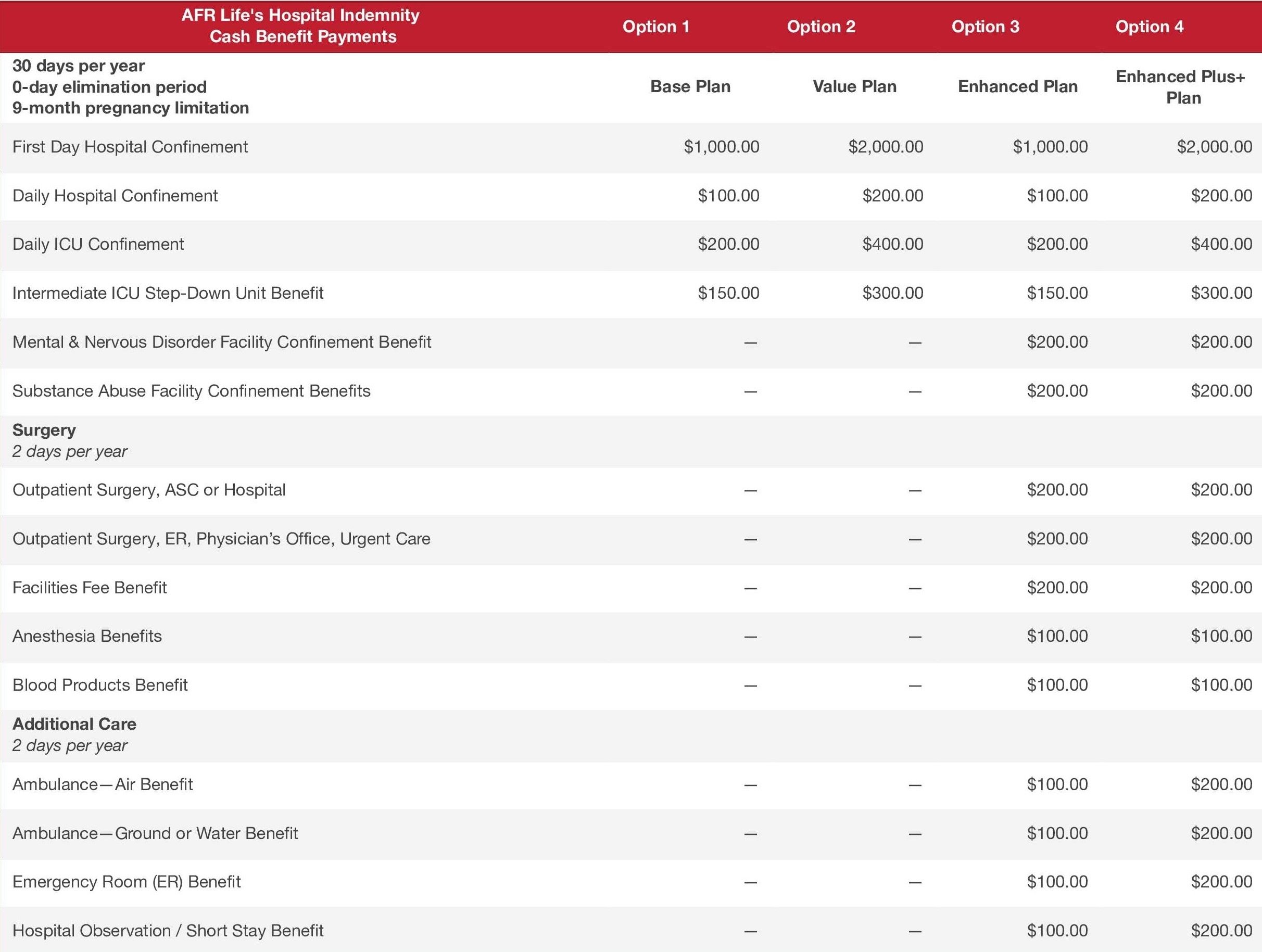
We offer multiple HI plan options, allowing employees to compare coverage levels and choose what best fits their needs. The chart below breaks down those options side by side, making it easier to see how each plan supports different hospital-related situations.
How Living Benefits Can Help During Chronic Illness
A chronic illness can reshape daily life.
A condition such as Alzheimer’s, mobility limitations, or a permanent inability to perform at least two activities of daily living can affect work, caregiving, housing, transportation, and long-term financial stability.
When Illness Affects Work, Home, and Daily Life
The costs may go far beyond medical treatment.
A family may need help with lost income, home healthcare, caregiving support, protecting savings, or modifying a home to accommodate physical restrictions. These expenses can create pressure over months or years, not just days.
How the Better Living Benefit Rider May Provide Support
If included in the policy, our Better Living Benefit Rider may provide living benefits if the insured is permanently unable to perform at least two activities of daily living (such as bathing, dressing, transferring, toileting, continence, eating, or experiences severe cognitive impairment). This can advance a portion of the death benefit and provide funds when they are most needed.
This is an important “know what your policy includes” moment. Not every policy includes the same features, and riders matter.
What to do next: Review your current coverage and ask whether it includes a chronic illness rider. If it does not, ask about the AFR Life Safeguard Term to 121 and whether coverage with a Better Living Benefit Rider may be available.
The Right Coverage Gives Families Time, Options, and Stability
Every situation is different, but the right coverage can help families:
- Keep bills current after a loss, injury, or hospital stay
- Avoid draining savings right away
- Stay in their home during a difficult transition
- Manage recovery-related costs
- Make decisions with more time and less pressure
That is what protection is really about: giving people practical support in hard moments, so they can move forward with more clarity, stability, and peace of mind.
How to Review Your Coverage Before Life Changes
Start by reviewing what you already have.
Look at your life insurance coverage amount, your beneficiary information, and any supplemental benefits available through work. Then ask yourself which risk feels most relevant right now:
- A job transition?
- An accident?
- A hospital stay?
- A chronic illness?
- Dependents who rely on your income or care?
Life insurance helps protect your family in the worst-case scenarios. Supplemental coverage, such as Accident Medical Expense and Hospital Indemnity, can help protect your budget during real-life situations involving injury, hospitalization, and recovery.
You should be prepared for all scenarios. Because when life does not go according to plan, your family deserves time, options, and support to move forward. Connect with an AFR Life specialist to learn more about your best next steps.